**Explain how to solve a non-right triangle with Law of Sines and Law of Cosines
1.) Law of Sines(used to non-right triangles):
Sin A/a = Sin B/b= Sin C/c
Example: you have a triangle with the sides 4 and 5 & you also have an angle of 30 degrees.
A = 1/2 (4) (5) Sin 30 degrees
A = 10 Sin 30 degrees which is aproximately = 5
2.) Law of Cosines (used when you can't use Law of Sines):
(opposite leg)^2 = (adjacent leg)^2 + (other adjacent leg)^2 - 2(adjacent leg) (adjacent leg) cos (angle between)
Example: you have a triangle with the sides of 5, 6, and 7. find the angle between 5 and 6.
7^2=6^2+5^2-2(5)(6)
cos a7^2-6^2-5^2= 2(5)(6)
cos acos a= 7^2-6^2-5^2 / -2(6)(5)
a= cos-1 ((7^2-^6^2-5^2)/(-2(5)(6))
a= 78.463 degrees
i hope that helps...
Thursday, April 29, 2010

Wednesday, April 28, 2010
Alicia's Blog Topic Response
Okay so I am going to explain the 2nd topic.
Law of Sines
(sinA)/a = (sinB)/b = (sinC)/c
*The law of sines is used when you know pairs in non-right triangles
*Basically, all your doing is setting up a proportion
Law of Cosines
(opposite leg)^2 = (adjacent leg)^2 + (other adjacent leg)^2 -2(adjacent leg)(adjacent leg)cos(angle between)
*When doing law of cosines, you should always use an angle to orient yourself like SOHCAHTOA!
Tuesday, April 27, 2010
Topics
Write a blog on one of the following
1. Explain in detail the steps to graphing a trig function
2. Explain how to solve a non-right triangle with Law of Sines and Law of Cosines
3. Explain how to know what type of polar graph you have given an equation
Monday, April 26, 2010
Stephen's Reflection
Ok so this week we did more stuff in the study guides for trig exam and yea..anyway im going to show you the half and double angle formulas for yall...
Half-Angle and Double Angle Formulas:
sin(2alpha) = 2sin(alpha)cos(alpha)
cos(2alpha) = cos^2(alpha)-sin^2(alpha)=1-2sin^2(alpha)=2cos^2
(alpha)-1
tan(2alpha) = 2tan(alpha)/1-tan^2(alpha)
sin(alpha/2)= +- sqrt(1-cos(alpha)/2)
cos(alpha/2)= +- sqrt(1+cos(alpha)/2)
tan(alpha/2)= +- sqrt(1-cos(alpha)/1+cos(alpha))=sin(alpha)/1+cos
(alpha)=1-cos(alpha)/sin(alpha)
Ok so like i said in class, everything with graphs is gonnneee. I need help working on conics and graphing them so if anyone can help i would be grateful
Half-Angle and Double Angle Formulas:
sin(2alpha) = 2sin(alpha)cos(alpha)
cos(2alpha) = cos^2(alpha)-sin^2(alpha)=1-2sin^2(alpha)=2cos^2
(alpha)-1
tan(2alpha) = 2tan(alpha)/1-tan^2(alpha)
sin(alpha/2)= +- sqrt(1-cos(alpha)/2)
cos(alpha/2)= +- sqrt(1+cos(alpha)/2)
tan(alpha/2)= +- sqrt(1-cos(alpha)/1+cos(alpha))=sin(alpha)/1+cos
(alpha)=1-cos(alpha)/sin(alpha)
Ok so like i said in class, everything with graphs is gonnneee. I need help working on conics and graphing them so if anyone can help i would be grateful
Trig Stuff
SOHCAHTOA:
Sin=opp/hyp
Cos=adj/hyp
Tan=opp/adj
Trig functions:
sin = y/r
cos = x/r
tan = y/x
csc = r/y
sec = r/x
cot = x/y
Law of sines:
(sinA)/a = (sinB)/b = (sinC)/c
Law of cosines:
(opposite leg)^2 = (adjacent leg)^2 + (other adjacent leg)^2 -2(adjacent leg)(adjacent leg)cos(angle between)
Sin=opp/hyp
Cos=adj/hyp
Tan=opp/adj
Trig functions:
sin = y/r
cos = x/r
tan = y/x
csc = r/y
sec = r/x
cot = x/y
Law of sines:
(sinA)/a = (sinB)/b = (sinC)/c
Law of cosines:
(opposite leg)^2 = (adjacent leg)^2 + (other adjacent leg)^2 -2(adjacent leg)(adjacent leg)cos(angle between)
Taylor reflection for 25 April 2010
Trig Identities
recriprocal relationships:
csc=1/ sin(theta)
sec=1/cos(theta)
cot=1/tan(theta)
relationships with negatives:
sin-theta= -sin(theta)
cos-theta= -cos(theta)
tan-theta= -tan(theta)
csc-theta= -csc(theta)
sec-theta= -sec(theta)
cot-theta= -cot(theta)
pythogorean relationships:
sin^2(theta)+cos^2(theta)=1
1+tan^2(theta)= sec^2(theta)
1+cot^2(theta)= csc^2(theta)
cofunction relationships:
sin(theta)= cos (90degrees-theta)
cos(theta)= sin (90degrees-theta)
tan(theta)= cot (90degrees-theta)
cot(theta)= tan (90degrees-theta)
sec(theta)= csc (90degrees-theta)
csc(theta)= sec (90degrees-theta)
***i need someone to give me tricks asto when to use each set of relationships to solve an equation
i.e. i need someone to help me recognize when each set of trig identities is necessary to be used
recriprocal relationships:
csc=1/ sin(theta)
sec=1/cos(theta)
cot=1/tan(theta)
relationships with negatives:
sin-theta= -sin(theta)
cos-theta= -cos(theta)
tan-theta= -tan(theta)
csc-theta= -csc(theta)
sec-theta= -sec(theta)
cot-theta= -cot(theta)
pythogorean relationships:
sin^2(theta)+cos^2(theta)=1
1+tan^2(theta)= sec^2(theta)
1+cot^2(theta)= csc^2(theta)
cofunction relationships:
sin(theta)= cos (90degrees-theta)
cos(theta)= sin (90degrees-theta)
tan(theta)= cot (90degrees-theta)
cot(theta)= tan (90degrees-theta)
sec(theta)= csc (90degrees-theta)
csc(theta)= sec (90degrees-theta)
***i need someone to give me tricks asto when to use each set of relationships to solve an equation
i.e. i need someone to help me recognize when each set of trig identities is necessary to be used
Sunday, April 25, 2010
Alicia's Reflection #36
Alrighty so I hope everyone enjoyed their weekend with senior day and prom :) Back to school and some more review for the trig exam on May 3rd and 4th. I am going to review some material for our trig exam from chapter 9 which was triangles.
SOHCAHTOA:
S = sin
O = opposite angle
H = hypotenuse
(sin = opposite/hypotenuse)
C = cos
A = adjacent angle
H = hypotenuse
(cos = adjacent/hypotenuse)
T = tan
O = opposite angle
A = adjacent angle
(tan = opposite/adjacent)
*the hypotenuse is opposite the right angle.
*A= 1/2 bh*
*To find the area of a non right triangle use this formula:
*A= 1/2 (leg)(leg)SIN(angle b/w)
*When you have a non right triangle that has pairs, use the law of sines:
Sin A/a = Sin B/b= Sin C/c
*All you are doing is setting up a proportion.
**Remember to solve for an angle, you have to take the inverse.
*To solve a triangle with no angles, use the Law of Cosines:
(opp leg)^2= (adj leg)^2 + (other adj leg)^2 -2(adj leg)(adj leg) Cos(angle b/w)
S = sin
O = opposite angle
H = hypotenuse
(sin = opposite/hypotenuse)
C = cos
A = adjacent angle
H = hypotenuse
(cos = adjacent/hypotenuse)
T = tan
O = opposite angle
A = adjacent angle
(tan = opposite/adjacent)
*the hypotenuse is opposite the right angle.
*A= 1/2 bh*
*To find the area of a non right triangle use this formula:
*A= 1/2 (leg)(leg)SIN(angle b/w)
*When you have a non right triangle that has pairs, use the law of sines:
Sin A/a = Sin B/b= Sin C/c
*All you are doing is setting up a proportion.
**Remember to solve for an angle, you have to take the inverse.
*To solve a triangle with no angles, use the Law of Cosines:
(opp leg)^2= (adj leg)^2 + (other adj leg)^2 -2(adj leg)(adj leg) Cos(angle b/w)
Stephanie's Reflection
Sum and Difference formulas for Cosine and Sine:
cos (alpha + or - beta) = cos(alpha)cos(beta) - or + sin(alpha)sin(beta)
sin (alpha + or - beta) = sin(alpha)cos(beta) + or - cos(alpha)sin(beta)
Half-Angle and Double-Angle Formulas:
sin(2alpha) = 2sin(alpha)cos(alpha)
cos(2alpha) = cos^2(alpha)-sin^2(alpha)=1-2sin^2(alpha)=2cos^2
(alpha)-1
tan(2alpha) = 2tan(alpha)/1-tan^2(alpha)
sin(alpha/2)= +- sqrt(1-cos(alpha)/2)
cos(alpha/2)= +- sqrt(1+cos(alpha)/2)
tan(alpha/2)= +- sqrt(1-cos(alpha)/1+cos(alpha))=sin(alpha)/1+cos
(alpha)=1-cos(alpha)/sin(alpha)
Recriprocal Relationships:
csc=1/ sin(theta)
sec=1/cos(theta)
cot=1/tan(theta)
Relationships With Negatives:
sin-theta= -sin(theta)
cos-theta= -cos(theta)
tan-theta= -tan(theta)
csc-theta= -csc(theta)
sec-theta= -sec(theta)
cot-theta= -cot(theta)
Pythogorean Relationships:
sin^2(theta)+cos^2(theta)=1
1+tan^2(theta)= sec^2(theta)
1+cot^2(theta)= csc^2(theta)
Cofunction Relationships:
sin(theta)= cos (90degrees-theta)
cos(theta)= sin (90degrees-theta)
tan(theta)= cot (90degrees-theta)
cot(theta)= tan (90degrees-theta)
sec(theta)= csc (90degrees-theta)
csc(theta)= sec (90degrees-theta)
cos (alpha + or - beta) = cos(alpha)cos(beta) - or + sin(alpha)sin(beta)
sin (alpha + or - beta) = sin(alpha)cos(beta) + or - cos(alpha)sin(beta)
Half-Angle and Double-Angle Formulas:
sin(2alpha) = 2sin(alpha)cos(alpha)
cos(2alpha) = cos^2(alpha)-sin^2(alpha)=1-2sin^2(alpha)=2cos^2
(alpha)-1
tan(2alpha) = 2tan(alpha)/1-tan^2(alpha)
sin(alpha/2)= +- sqrt(1-cos(alpha)/2)
cos(alpha/2)= +- sqrt(1+cos(alpha)/2)
tan(alpha/2)= +- sqrt(1-cos(alpha)/1+cos(alpha))=sin(alpha)/1+cos
(alpha)=1-cos(alpha)/sin(alpha)
Recriprocal Relationships:
csc=1/ sin(theta)
sec=1/cos(theta)
cot=1/tan(theta)
Relationships With Negatives:
sin-theta= -sin(theta)
cos-theta= -cos(theta)
tan-theta= -tan(theta)
csc-theta= -csc(theta)
sec-theta= -sec(theta)
cot-theta= -cot(theta)
Pythogorean Relationships:
sin^2(theta)+cos^2(theta)=1
1+tan^2(theta)= sec^2(theta)
1+cot^2(theta)= csc^2(theta)
Cofunction Relationships:
sin(theta)= cos (90degrees-theta)
cos(theta)= sin (90degrees-theta)
tan(theta)= cot (90degrees-theta)
cot(theta)= tan (90degrees-theta)
sec(theta)= csc (90degrees-theta)
csc(theta)= sec (90degrees-theta)
Reflection
Some Trig Stuff...
The Unit Circle
90 degrees, (0,1), pi/2
180 degrees, (-1,0), pi
270 degrees, (0,-1), 3pi/2
360 degrees, (1,0), 2pi
6 Trig Functions
sin = y/r
cos = x/r
tan = y/x
csc = r/y
sec = r/x
cot = x/y
Degrees & Radians
Degrees to radians= Degree * pi/180
Radians to degrees= Radians * 180/pi
The Unit Circle
90 degrees, (0,1), pi/2
180 degrees, (-1,0), pi
270 degrees, (0,-1), 3pi/2
360 degrees, (1,0), 2pi
6 Trig Functions
sin = y/r
cos = x/r
tan = y/x
csc = r/y
sec = r/x
cot = x/y
Degrees & Radians
Degrees to radians= Degree * pi/180
Radians to degrees= Radians * 180/pi
Saturday, April 24, 2010
Amy's Reflection #36
Since our trig exam is coming up here a review on chapter 10...
Sum and Difference formulas for Cosine and Sine:
cos (alpha + or - beta) = cos(alpha)cos(beta) - or + sin(alpha)sin(beta)
sin (alpha + or - beta) = sin(alpha)cos(beta) + or - cos(alpha)sin(beta)
Rewriting a Sum or Difference as a Product:
sin(x) + sin(y) = 2sin(x+y/2)cos(x-y/2)
sin(x) - sin(y) = 2cos(x+y/2)sin(x-y/2)
cos(x) + cos(y) = 2cos(x+y/2)cos(x-y/2)
cos(x) - cos(y) = -2sin(x+y/2)sin(x-y/2)
**we didn't use these formulas for anything..so i got no idea where to use them..
Half-Angle and Double Angle Formulas:
sin(2alpha) = 2sin(alpha)cos(alpha)
cos(2alpha) = cos^2(alpha)-sin^2(alpha)=1-2sin^2(alpha)=2cos^2
(alpha)-1
tan(2alpha) = 2tan(alpha)/1-tan^2(alpha)
sin(alpha/2)= +- sqrt(1-cos(alpha)/2)
cos(alpha/2)= +- sqrt(1+cos(alpha)/2)
tan(alpha/2)= +- sqrt(1-cos(alpha)/1+cos(alpha))=sin(alpha)/1+cos
(alpha)=1-cos(alpha)/sin(alpha)
now here are some examples:
1. tan α = 2 and tan β=1, find tan (α - β)
= tan α + tan β/1-tan α tan β
=2+1/1-(2)(6)
=3/-1
=-3
2. Find the exact value of: tan 15+tan 30/1-tan 15 tan 30
tan α = 2 and tan β=1
find tan (α - β)
= tan (15 + 30)
=tan (45)
=1
3. Find the exact value of sin 15degrees
*exact value means you use your trig chart
*think of two numbers from the trig chart can either add or subtract to give you 15
*since it's (45-30), you would look for the formula that uses sin
sin (a-B) = sin a cos B - cos a sin B
* plug #s into equation..
a=45 degrees B=30 degrees
sin (45-30) = sin 45 cos 30 - cos 45 sin 30
sin (a-B) = sin a cos B - cos a sin B
sin (45-30) = sin 45 cos 30 - cos 45 sin 30
sin 15 = (square root of 2 over 2)(square root of 3 over 2) - (square root of 2 over 2)(1/2)
sin 15 degrees = (square root of 6 over 4) - (square root of 2 over 4)
= square root of 6 - square root of 2 all over 4
i hope this will help refreshen someone's memory :)
Sum and Difference formulas for Cosine and Sine:
cos (alpha + or - beta) = cos(alpha)cos(beta) - or + sin(alpha)sin(beta)
sin (alpha + or - beta) = sin(alpha)cos(beta) + or - cos(alpha)sin(beta)
Rewriting a Sum or Difference as a Product:
sin(x) + sin(y) = 2sin(x+y/2)cos(x-y/2)
sin(x) - sin(y) = 2cos(x+y/2)sin(x-y/2)
cos(x) + cos(y) = 2cos(x+y/2)cos(x-y/2)
cos(x) - cos(y) = -2sin(x+y/2)sin(x-y/2)
**we didn't use these formulas for anything..so i got no idea where to use them..
Half-Angle and Double Angle Formulas:
sin(2alpha) = 2sin(alpha)cos(alpha)
cos(2alpha) = cos^2(alpha)-sin^2(alpha)=1-2sin^2(alpha)=2cos^2
(alpha)-1
tan(2alpha) = 2tan(alpha)/1-tan^2(alpha)
sin(alpha/2)= +- sqrt(1-cos(alpha)/2)
cos(alpha/2)= +- sqrt(1+cos(alpha)/2)
tan(alpha/2)= +- sqrt(1-cos(alpha)/1+cos(alpha))=sin(alpha)/1+cos
(alpha)=1-cos(alpha)/sin(alpha)
now here are some examples:
1. tan α = 2 and tan β=1, find tan (α - β)
= tan α + tan β/1-tan α tan β
=2+1/1-(2)(6)
=3/-1
=-3
2. Find the exact value of: tan 15+tan 30/1-tan 15 tan 30
tan α = 2 and tan β=1
find tan (α - β)
= tan (15 + 30)
=tan (45)
=1
3. Find the exact value of sin 15degrees
*exact value means you use your trig chart
*think of two numbers from the trig chart can either add or subtract to give you 15
*since it's (45-30), you would look for the formula that uses sin
sin (a-B) = sin a cos B - cos a sin B
* plug #s into equation..
a=45 degrees B=30 degrees
sin (45-30) = sin 45 cos 30 - cos 45 sin 30
sin (a-B) = sin a cos B - cos a sin B
sin (45-30) = sin 45 cos 30 - cos 45 sin 30
sin 15 = (square root of 2 over 2)(square root of 3 over 2) - (square root of 2 over 2)(1/2)
sin 15 degrees = (square root of 6 over 4) - (square root of 2 over 4)
= square root of 6 - square root of 2 all over 4
i hope this will help refreshen someone's memory :)
Thursday, April 22, 2010
Terrio-Reference Angles
Reference Angles have to be between 0° and 90°. First, find which quadrant the angle is in. Next, determine whether the sign is positive or negative in that quadrant. Last, subtract 180° until the angle is between 0° and 90°.
Moving To Different Quadrants:
I to II/II to III/III to IV= make negative and add 180°
I to III = add 180°
I to IV = make negative and add 360°
II to IV = add 180°
Moving To Different Quadrants:
I to II/II to III/III to IV= make negative and add 180°
I to III = add 180°
I to IV = make negative and add 360°
II to IV = add 180°
Wednesday, April 21, 2010
Reference Angles
A reference angle must be between oº and 90º, it is used when an angle is not found on the trig chart or unit circle.
To find the reference angle: First find what quadrant the angle is in, next determine the sign of the quadrant (positive or negative?) that the trig function is in, lastly subtract 180º until the angle is between 0º and 90º
Amy's Blog Topic
Reference Angles:
(must be between 0° and 90°)
1)find which quadrant angle is in
2)determine the sign in that quadrant (+ve or -ve)
3)subtract 180° until the angle is between 0° and 90° (0 and π/2)
1)find the reference angle using chart or calculator
2)find what quadrant you need to be in based on the sign of the value
3)use notes to move to that quadrant
**To Move:
I to IV = make negative and add 360°
I to III = add 180°
I to II = make negative and add 180°
II to IV = add 180°
1. The reference angle in the 1st quad is equal to the angle measure.
Example- θ = 60 = 60
2. To find the reference angle in the 2nd quad just subtract the angle from 180°.
Example- θ = 130° = 180° -130°= 50°
3. To find the reference angle in the 3rd quad subtract 180° from the angle given.
Example- θ = 240° = 240° - 180° = 60°
4. To find the reference angle in the 4th quad simply subtracting the angle from 360° will provide the reference angle in the 4th quad.
Example- θ = 315° = 360° -315° = 45°
other examples:
1. sin^-1(-√2/2) = 45°
45 + 180 = 225° = θ
I to IV
-45 + 360 = 315°
θ = 225°, 315°
2. Find the reference angle for sin210°
1. lies in quadrant 3
2. sin is negative in quadrant 3
3. 210-180=30
sin210°= -sin30
you would then look to your trig chart and find a reference to sin 30 (π/6)
sin 210°=1/2
(must be between 0° and 90°)
1)find which quadrant angle is in
2)determine the sign in that quadrant (+ve or -ve)
3)subtract 180° until the angle is between 0° and 90° (0 and π/2)
1)find the reference angle using chart or calculator
2)find what quadrant you need to be in based on the sign of the value
3)use notes to move to that quadrant
**To Move:
I to IV = make negative and add 360°
I to III = add 180°
I to II = make negative and add 180°
II to IV = add 180°
1. The reference angle in the 1st quad is equal to the angle measure.
Example- θ = 60 = 60
2. To find the reference angle in the 2nd quad just subtract the angle from 180°.
Example- θ = 130° = 180° -130°= 50°
3. To find the reference angle in the 3rd quad subtract 180° from the angle given.
Example- θ = 240° = 240° - 180° = 60°
4. To find the reference angle in the 4th quad simply subtracting the angle from 360° will provide the reference angle in the 4th quad.
Example- θ = 315° = 360° -315° = 45°
other examples:
1. sin^-1(-√2/2) = 45°
45 + 180 = 225° = θ
I to IV
-45 + 360 = 315°
θ = 225°, 315°
2. Find the reference angle for sin210°
1. lies in quadrant 3
2. sin is negative in quadrant 3
3. 210-180=30
sin210°= -sin30
you would then look to your trig chart and find a reference to sin 30 (π/6)
sin 210°=1/2
Stephen's Reflection
Ok so this blog is about law of sines and cosines. You use this to find angles and sides of non right triangles.
When you have a non right triangle that has pairs, use the law of sines:
Sin A/a = Sin B/b= Sin C/c
*All you are doing is setting up a proportion.
**Remember to solve for an angle, you have to take the inverse.
*To solve a triangle with no angles, use the Law of Cosines:
(opp leg)^2= (adj leg)^2 + (other adj leg)^2 -2(adj leg)(adj leg) Cos(angle b/w)
I forget how to use steps for circles and ellipses and stuff like that
When you have a non right triangle that has pairs, use the law of sines:
Sin A/a = Sin B/b= Sin C/c
*All you are doing is setting up a proportion.
**Remember to solve for an angle, you have to take the inverse.
*To solve a triangle with no angles, use the Law of Cosines:
(opp leg)^2= (adj leg)^2 + (other adj leg)^2 -2(adj leg)(adj leg) Cos(angle b/w)
I forget how to use steps for circles and ellipses and stuff like that
Alicia's Blog topic
okay so im going to explain the 3rd topic, how to find a reference angle.
Finding a reference angle is used when the angle does not appear on the trig chart or unit circle.
First, set up your blanks before and after your trig function
Example: ____SIN_____
The first blank is where you put positive or negative depending on the trig functions quadrant
The second blank is where you put the reference angle you find
The point of the reference angle is to get your angle that you are given between 0 and 90 degrees.
When finding reference angles, you can either add or subtract 360 and 180 to your angle depending on how big or small the number is.
The final number that you get should be between 0 and 90 degrees. This is the number that goes in the second blank
To determine positive or negative, you have to know your trig functions quadrants.
Example: SIN is positive is quadrant I & II. Negative in III & IV
Hope this helped!!!
Goodluck on the trig exam.
If anyone wants to make a study group I would like to be in it :)
Finding a reference angle is used when the angle does not appear on the trig chart or unit circle.
First, set up your blanks before and after your trig function
Example: ____SIN_____
The first blank is where you put positive or negative depending on the trig functions quadrant
The second blank is where you put the reference angle you find
The point of the reference angle is to get your angle that you are given between 0 and 90 degrees.
When finding reference angles, you can either add or subtract 360 and 180 to your angle depending on how big or small the number is.
The final number that you get should be between 0 and 90 degrees. This is the number that goes in the second blank
To determine positive or negative, you have to know your trig functions quadrants.
Example: SIN is positive is quadrant I & II. Negative in III & IV
Hope this helped!!!
Goodluck on the trig exam.
If anyone wants to make a study group I would like to be in it :)
Stephanie's Reflection
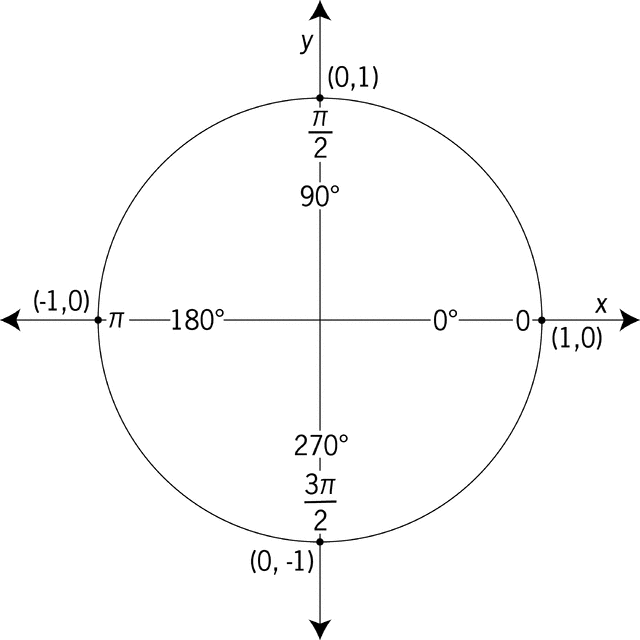
you use a unit circle with the trig chart
it is also used when you want to change what quad you are in
and you can use it to figure out where sin, cos, etc. are positive and negative
to change what quad you are in, you can change the number to negative and add 360 or change the number to negative and add 180 (i forget the other one)
to figure out where sin, cos, etc. are positive and negative, you simply see what it equals (eg: sin = y/r means that wherever y is positive, sin is positive and wherever y is negative, sin is negative)
Tuesday, April 20, 2010
taylor blog topic from brob #1
i chose to answer
3.How to find a reference angle
there are three steps to finding a refrence angle
STEPS
pre step- set up ____ trig function____
the rest will plug into this
#1- discover which quadrent the given angle is in
#2- determine if the given trig function ((which will go in the "trig function" spot)) is positive or negative in that quadrent ((this will go into the first blank))
#3- change given angle to some number between 0 and 90 degrees by subtracting 180 until the angle is between 0 and 90 degrees. ((the number that you get which is between 0 and 90 degrees will go in the second blank))
Thats it! good luck
study study study
3.How to find a reference angle
there are three steps to finding a refrence angle
STEPS
pre step- set up ____ trig function____
the rest will plug into this
#1- discover which quadrent the given angle is in
#2- determine if the given trig function ((which will go in the "trig function" spot)) is positive or negative in that quadrent ((this will go into the first blank))
#3- change given angle to some number between 0 and 90 degrees by subtracting 180 until the angle is between 0 and 90 degrees. ((the number that you get which is between 0 and 90 degrees will go in the second blank))
Thats it! good luck
study study study
Monday, April 19, 2010
Blog Topic
The Second Blog topic for this week is to explain one of the following:
1. How to use the unit circle
2. How to solve for an angle
3.How to find a reference angle
Taylor reflection for 18 April
NOTES FOR TRIG REVIEW CHAPTER 9 ((Triangles))
SOHCAHTOA:
S = sin
O = opposite angle
H = hypotenuse
(sin = opposite/hypotenuse)
C = cos
A = adjacent angle
H = hypotenuse
(cos = adjacent/hypotenuse)
T = tan
O = opposite angle
A = adjacent angle
(tan = opposite/adjacent)
*the hypotenuse is opposite the right angle.
*A= 1/2 bh*
*To find the area of a non right triangle use this formula:
*A= 1/2 (leg)(leg)SIN(angle b/w)
*When you have a non right triangle that has pairs, use the law of sines:
Sin A/a = Sin B/b= Sin C/c
*All you are doing is setting up a proportion.
**Remember to solve for an angle, you have to take the inverse.
*To solve a triangle with no angles, use the Law of Cosines:
(opp leg)^2= (adj leg)^2 + (other adj leg)^2 -2(adj leg)(adj leg) Cos(angle b/w)
i need someone to give me the formula for area of an inscribed shape please =)
SOHCAHTOA:
S = sin
O = opposite angle
H = hypotenuse
(sin = opposite/hypotenuse)
C = cos
A = adjacent angle
H = hypotenuse
(cos = adjacent/hypotenuse)
T = tan
O = opposite angle
A = adjacent angle
(tan = opposite/adjacent)
*the hypotenuse is opposite the right angle.
*A= 1/2 bh*
*To find the area of a non right triangle use this formula:
*A= 1/2 (leg)(leg)SIN(angle b/w)
*When you have a non right triangle that has pairs, use the law of sines:
Sin A/a = Sin B/b= Sin C/c
*All you are doing is setting up a proportion.
**Remember to solve for an angle, you have to take the inverse.
*To solve a triangle with no angles, use the Law of Cosines:
(opp leg)^2= (adj leg)^2 + (other adj leg)^2 -2(adj leg)(adj leg) Cos(angle b/w)
i need someone to give me the formula for area of an inscribed shape please =)
Sunday, April 18, 2010
Amy's Reflection #35
okay here is some stuff we learned this week..
Vector Operations with Coordinates
Vector Addition: v + u = (a, b) + (c, d) = (a + c, b + d)
Vector Subtraction: v - u = (a, b)-(c, d) = (a - c, b - d)
Scalar Multiplication: kv = k(a, b) = (ka, kb)
The Dot Product
If v1 = (x1, y1) and v2 = (x2, y2) then the dot product, denoted by v1•v2 is defined by: v1•v2 = x1x2 + y1y2.
Properties of the Dot Product
1. u • v = v • u
2. u • u = |u|²
3. k(u • v) = (ku) • v
4. u • (v + w) = u • v + u • w
**if two vectors are orthogonal, the dot product=0
**if two vectors are parallel, then x2/x1=y2/y1
Mid point formula: (x1+x2/2, y1+y2/2, z1+z2/2)
Example:
1. u= (3,-6) v= (4,2) w= (-12, -6)
show that u&v are perpendicular and that v&w are parallel.
u . v= 3(4)+(-6)(2)=0
-12/4 = -6/2
-3 = -3
2. Find the midpoint of (2,2,2) and (2,4,6)
= 2+2/2, 2+4/2, 2+6/2
= (2, 3, 4)
okay i also need help in remembering some trig stuff so any review on anything would be appreciated..
Vector Operations with Coordinates
Vector Addition: v + u = (a, b) + (c, d) = (a + c, b + d)
Vector Subtraction: v - u = (a, b)-(c, d) = (a - c, b - d)
Scalar Multiplication: kv = k(a, b) = (ka, kb)
The Dot Product
If v1 = (x1, y1) and v2 = (x2, y2) then the dot product, denoted by v1•v2 is defined by: v1•v2 = x1x2 + y1y2.
Properties of the Dot Product
1. u • v = v • u
2. u • u = |u|²
3. k(u • v) = (ku) • v
4. u • (v + w) = u • v + u • w
**if two vectors are orthogonal, the dot product=0
**if two vectors are parallel, then x2/x1=y2/y1
Mid point formula: (x1+x2/2, y1+y2/2, z1+z2/2)
Example:
1. u= (3,-6) v= (4,2) w= (-12, -6)
show that u&v are perpendicular and that v&w are parallel.
u . v= 3(4)+(-6)(2)=0
-12/4 = -6/2
-3 = -3
2. Find the midpoint of (2,2,2) and (2,4,6)
= 2+2/2, 2+4/2, 2+6/2
= (2, 3, 4)
okay i also need help in remembering some trig stuff so any review on anything would be appreciated..
Vector Formulæ
New Vocabulary: Orthogonal = Perpendicular
Vector Operations with Coordinates
Vector Addition: v + u = (a, b) + (c, d) = (a + c, b + d)
Vector Subtraction: v - u = (a, b)-(c, d) = (a - c, b - d)
Scalar Multiplication: kv = k(a, b) = (ka, kb)
The Dot Product
If v1 = (x1, y1) and v2 = (x2, y2) then the dot product, denoted by v1•v2 is defined by
v1•v2 = x1x2 + y1y2.
Properties of the Dot Product
1. u • v = v • u
2. u • u = |u|²
3. k(u • v) = (ku) • v
4. u • (v + w) = u • v + u • w
Stephen's Reflection
Ok so this week we learned about vectors and some other stuff i dont really remember..ANNYYYWAYY..one thing i know is whether vectors are orthogonal or parallel. there are a few formluas to figure out if they are orthogonal..4 to be exact..
1. u . v= v . u
2. u . u= /u/^2
3. k(u . v)= (ku) . v
4. u . (v+w)= u . v+ u . w
It is orthogonal if it equals 0.
Ok so i forget alot of trig stuff like law of sines and law of cosines so i need help with that
1. u . v= v . u
2. u . u= /u/^2
3. k(u . v)= (ku) . v
4. u . (v+w)= u . v+ u . w
It is orthogonal if it equals 0.
Ok so i forget alot of trig stuff like law of sines and law of cosines so i need help with that
Alicia's Reflection #35
Alrighty so this week we learned Chapter 12 Vectors and we had a take home test this weekend thats due tomorrow... Dont Forget!!! I am going to review what we learned in chapter 12.
Another word that means perdencidular is orthogonal.
To figure out if two vectors are orthogonal, find the dot product.
v1 . v2=x1 x2 + y1 y2
**the dot does not imply multiplication.
Properties
1. u . v= v . u
2. u . u= /u/^2
3. k(u . v)= (ku) . v
4. u . (v+w)= u . v+ u . w
u=(x1 , y2)
y=(x2 , y2)
z=(x3 , y3)
Prove the 4 Properties
if two vectors are orthogonal, the dot product=0
if two vectors are parallel, then x2/x1=y2/y1
Example:
u= (3,-6) v= (4,2) w= (-12, -6)
show that u&v are perpendicular and that v&w are parallel.
u . v= 3(4)+(-6)(2)=0
-12/4=-6/2
-3=-3
I could use some help with determinants like on our take home test where there is 4 columns and 4 rows.
Another word that means perdencidular is orthogonal.
To figure out if two vectors are orthogonal, find the dot product.
v1 . v2=x1 x2 + y1 y2
**the dot does not imply multiplication.
Properties
1. u . v= v . u
2. u . u= /u/^2
3. k(u . v)= (ku) . v
4. u . (v+w)= u . v+ u . w
u=(x1 , y2)
y=(x2 , y2)
z=(x3 , y3)
Prove the 4 Properties
if two vectors are orthogonal, the dot product=0
if two vectors are parallel, then x2/x1=y2/y1
Example:
u= (3,-6) v= (4,2) w= (-12, -6)
show that u&v are perpendicular and that v&w are parallel.
u . v= 3(4)+(-6)(2)=0
-12/4=-6/2
-3=-3
I could use some help with determinants like on our take home test where there is 4 columns and 4 rows.
Reflection
This week we learned a lot of new stuff. We learned about vectors, did some midpoint stuff, distance formula stuff, and all kinds of different math STUFF haha. This week wasn't too bad, I thought it was all pretty easy for the most part. Here is an example of one of the things we did this week.
MIDPOINT OF 3-D VECTORS:
Find the midpoint of (2,2,2) and (2,4,6)
-plug it into the formula m = (x1+x2/2, y1+y2/2, z1+z2/2)
-so 2+2/2, 2+4/2, 2+6/2
then you simplify it and you get (2, 3, 4)
MIDPOINT OF 3-D VECTORS:
Find the midpoint of (2,2,2) and (2,4,6)
-plug it into the formula m = (x1+x2/2, y1+y2/2, z1+z2/2)
-so 2+2/2, 2+4/2, 2+6/2
then you simplify it and you get (2, 3, 4)
Stephanie's Reflection
Trig Chart:
0°
sin0=0
cos0=1
tan0=undefined
sec0=1
cot0=0
30°
sinπ/6=1/2
cosπ/6=√3/2
tanπ/6=√3/3
cscπ/6=2
secπ/6=2 √3/3
cotπ/6=√3
45°
sinπ/4=√2/2
cosπ/4=√2/2
tanπ/4=1
cscπ/4=√2
secπ/4=√2
cotπ/4=1
60°
sinπ/3=√3/2
cosπ/3=1/2
tanπ/3=√3
cscπ/3=2 √3/3
secπ/3=2
cotπ/3=√3/2
90°
sinπ/2=1
cosπ/2=0
tanπ/2=undefined
cscπ/2=1
secπ/2=undefined
cotπ/2=0
0°
sin0=0
cos0=1
tan0=undefined
sec0=1
cot0=0
30°
sinπ/6=1/2
cosπ/6=√3/2
tanπ/6=√3/3
cscπ/6=2
secπ/6=2 √3/3
cotπ/6=√3
45°
sinπ/4=√2/2
cosπ/4=√2/2
tanπ/4=1
cscπ/4=√2
secπ/4=√2
cotπ/4=1
60°
sinπ/3=√3/2
cosπ/3=1/2
tanπ/3=√3
cscπ/3=2 √3/3
secπ/3=2
cotπ/3=√3/2
90°
sinπ/2=1
cosπ/2=0
tanπ/2=undefined
cscπ/2=1
secπ/2=undefined
cotπ/2=0
Monday, April 12, 2010
Taylor reflection 11 April
This week we will start reviewing for the trig exam
so i will start posting trig notes for each chapter
Angles are measured in DEGREES (possibly with either minutes' or minutes' andseconds")
and RADIANS
To find minutes
multiply what is behind the decimal by 60
and take whole number as minutes'
To find seconds
multiply what is behind the decimal of minutes by 60
then whats behind that decimal by 3600 to get seconds'
To get radians
degrees x pi/180degrees
((***Remember to always ues exact answers))
((*** Remember to never plug pi into calculator))
Unit Circle:
90 degs. = (0,1) pi/2
180 degs. = (-1,0) pi2
70 degs. = (0,-1) 3pi/2
360 degs. = (1,0) 2pi
sin=y/r
cos=x/r
tan=y/x
cot=x/y
sec=r/x
csc=r/y
i need someone to provide me with the formulas neccessary to have memorized for chapter eight and then i need someone to help me figure out any tricks they may know for solving chapter eight
a quick tip overview of chapter eight may be easiest.
so i will start posting trig notes for each chapter
Angles are measured in DEGREES (possibly with either minutes' or minutes' andseconds")
and RADIANS
To find minutes
multiply what is behind the decimal by 60
and take whole number as minutes'
To find seconds
multiply what is behind the decimal of minutes by 60
then whats behind that decimal by 3600 to get seconds'
To get radians
degrees x pi/180degrees
((***Remember to always ues exact answers))
((*** Remember to never plug pi into calculator))
Unit Circle:
90 degs. = (0,1) pi/2
180 degs. = (-1,0) pi2
70 degs. = (0,-1) 3pi/2
360 degs. = (1,0) 2pi
sin=y/r
cos=x/r
tan=y/x
cot=x/y
sec=r/x
csc=r/y
i need someone to provide me with the formulas neccessary to have memorized for chapter eight and then i need someone to help me figure out any tricks they may know for solving chapter eight
a quick tip overview of chapter eight may be easiest.
Sunday, April 11, 2010
Stephen's reflection
Ok so yea i dont want school tomorrow and i forgot a bunch of stuff sooo yea..anyway i will talk about some trig stuff like SOHCAHTOA, law of sines and law of cosines..these are the formulas you use and the rest is reallllyyyy easy soooo yea.
SOHCAHTOA
sinΘ=opposite leg/hypotenuse
cosΘ=adjacent leg/hypotenuse
tanΘ=opposite leg/adjacent leg
Law of Sines
sinA/a - sinB/b = sinC/c
(used when you know pairs or opposites in a non-right triangle)
Law of Cosines
(opposite leg)²=(adjacent leg)² + (other leg)² - 2(adjacent leg)(adjacent leg)cos°
Ok so what i dont really remember is i can use help on limits and sigma notation..i forgot all that stuff
SOHCAHTOA
sinΘ=opposite leg/hypotenuse
cosΘ=adjacent leg/hypotenuse
tanΘ=opposite leg/adjacent leg
Law of Sines
sinA/a - sinB/b = sinC/c
(used when you know pairs or opposites in a non-right triangle)
Law of Cosines
(opposite leg)²=(adjacent leg)² + (other leg)² - 2(adjacent leg)(adjacent leg)cos°
Ok so what i dont really remember is i can use help on limits and sigma notation..i forgot all that stuff
Stephen's Make up blog over easter
Ok soooo i completely shut out all school work and forgot to do this and my mom hasseled me to do it today soooooo yea...this is a few things from chapter 13..just a formula or two.
1. sequence-list of numbers
2. two main types: 1). arithmetic-add or subtract 2).geometric-multiply
Formulas:
1. arithmetic-used to find a term: tn . t1 + (n-1)d
**n=term #, t1=first term, d=what you add, tn=term #
2. geometric: tn=t1 . r^(n-1)
Ok theres alot i forgot..but if someone can give me the formulas from our last section i will be happy :)
1. sequence-list of numbers
2. two main types: 1). arithmetic-add or subtract 2).geometric-multiply
Formulas:
1. arithmetic-used to find a term: tn . t1 + (n-1)d
**n=term #, t1=first term, d=what you add, tn=term #
2. geometric: tn=t1 . r^(n-1)
Ok theres alot i forgot..but if someone can give me the formulas from our last section i will be happy :)
Well spring break is over...this sucks. Back to math, here's some old stuff that we did back in the gap.
SOHCAHTOA
sinΘ=opposite leg/hypotenuse
cosΘ=adjacent leg/hypotenuse
tanΘ=opposite leg/adjacent leg
Law of Sines
sinA/a - sinB/b = sinC/c
(used when you know pairs or opposites in a non-right triangle)
Law of Cosines
(opposite leg)²=(adjacent leg)² + (other leg)² - 2(adjacent leg)(adjacent leg)cos°
Something that I need some help with, and it seems like a lot of people are having trouble with this too, is Integral Coefficients....
SOHCAHTOA
sinΘ=opposite leg/hypotenuse
cosΘ=adjacent leg/hypotenuse
tanΘ=opposite leg/adjacent leg
Law of Sines
sinA/a - sinB/b = sinC/c
(used when you know pairs or opposites in a non-right triangle)
Law of Cosines
(opposite leg)²=(adjacent leg)² + (other leg)² - 2(adjacent leg)(adjacent leg)cos°
Something that I need some help with, and it seems like a lot of people are having trouble with this too, is Integral Coefficients....
alaina's blog, 11 april 2010
i'm going over old stuff, and for the most part, i remember everything. so i'm explaining how to complete the square.
when given an equation (ax^2+bx+c=0) where "c" is the constant, first add or subtract the constant over (ax^2+bx+_=-c). Second, divide the linear term (b) by two and then square it (b/2)^2. Your would then add your squared, lets call it "d", term to both sides of the equal sign (ax^2+bx+d=-c+d). You would then factor to get (ax+b/2)^2=-c+d. After factoring, you would take the square root of both sides (ax+b/2)=+/- √-c+d. Then, you would add or subtract (b/2) to both sides. And finally, you would divide by "a" to get "x" by itself. You would then write in coordinate form.
What I don't understand from the exam review is how to get an equation from INTEGRAL COEFFICIENTS!!!!! help.
when given an equation (ax^2+bx+c=0) where "c" is the constant, first add or subtract the constant over (ax^2+bx+_=-c). Second, divide the linear term (b) by two and then square it (b/2)^2. Your would then add your squared, lets call it "d", term to both sides of the equal sign (ax^2+bx+d=-c+d). You would then factor to get (ax+b/2)^2=-c+d. After factoring, you would take the square root of both sides (ax+b/2)=+/- √-c+d. Then, you would add or subtract (b/2) to both sides. And finally, you would divide by "a" to get "x" by itself. You would then write in coordinate form.
What I don't understand from the exam review is how to get an equation from INTEGRAL COEFFICIENTS!!!!! help.
alaina's makeup blog for 28 March 2010
Okay, so this week I have been completely bogged down with studying for exams and keeping up with notes and homework in everything else. And, I almost forgot to do my reflection. So here goes.
First, I understand conics a lot better than I did last year, or durring the summer.
Circle
(x-h)^2+(y-k)^2=r^2
I always thought circles were easiest.
Your center is (h,k)
radius=r; take square root of r^2
to graph, plot your center and count your radius all the way around.
Ellipse
(x^2+h/a^2)-(y^2+k/b^2)=1
Your center is (h,k)
Your major axis is the non-negative denominator
minor is negative
Hyperbola
(x^2-h/a^2)+(y^2-k/b^2)=1
Your center is (h,k)
your major axis has the larger denominator
Parabola
y-y⊂1&sub/=m(x-x&sub/1)
**don't understand**
sigma notation i could use a little help on, also INTEGRAL COOEFFICIENTS!!!
First, I understand conics a lot better than I did last year, or durring the summer.
Circle
(x-h)^2+(y-k)^2=r^2
I always thought circles were easiest.
Your center is (h,k)
radius=r; take square root of r^2
to graph, plot your center and count your radius all the way around.
Ellipse
(x^2+h/a^2)-(y^2+k/b^2)=1
Your center is (h,k)
Your major axis is the non-negative denominator
minor is negative
Hyperbola
(x^2-h/a^2)+(y^2-k/b^2)=1
Your center is (h,k)
your major axis has the larger denominator
Parabola
y-y⊂1&sub/=m(x-x&sub/1)
**don't understand**
sigma notation i could use a little help on, also INTEGRAL COOEFFICIENTS!!!
Stephanie's Reflection
3) (2+4i)²
(2+4i)(2+4i)
4+8i+8i+16i²
4+16i-16i²
-12+16i²
.25 = i = complex # = √(-1)
.5 = i² = -1
.75 = i³ = -i
whole # = i^4 = i
(divide exponent by 4)
a+bi form
4) 5-2i
4+3i
5-2i 4-3i
4+3i * 4-3i
20-15i-8i+6i²
16-10i+12i-9i²
20-23i-6
16+9
14-23i
25
=14/25+23/25i
5) 2+6i 4+2i
4-2i * 4+2i
8+4i+24+12i²
16+4i²
8+28i+12
16+4
20+28i
20
=1+7/5i
(2+4i)(2+4i)
4+8i+8i+16i²
4+16i-16i²
-12+16i²
.25 = i = complex # = √(-1)
.5 = i² = -1
.75 = i³ = -i
whole # = i^4 = i
(divide exponent by 4)
a+bi form
4) 5-2i
4+3i
5-2i 4-3i
4+3i * 4-3i
20-15i-8i+6i²
16-10i+12i-9i²
20-23i-6
16+9
14-23i
25
=14/25+23/25i
5) 2+6i 4+2i
4-2i * 4+2i
8+4i+24+12i²
16+4i²
8+28i+12
16+4
20+28i
20
=1+7/5i
Saturday, April 10, 2010
Amy's Relfection #34 (Easter Blog)
okay now here is a review on some trig questions...
Example 1: Find the exact value of sin 80 cos 130+ cos 80 sin 130
Let alpha = 80 and beta = 130 then sin 80 cos 130 + cos 80sin 130 = sin alpha cos beta + cos alpha sin b
= sin (alpha + beta)
= sin (80+130)
= sin (210)
= sin (180 + 30)
= - sin 30
= -1/2
Example 2: Find the exact value of
cos^215 - sin^215 = cos(2alpha)
= cos(30)
= sqrt 3/2
Example 3: cos 15
alpha = 45, beta = 30
cos (alpha - beta) = cos 45 cos30 + sin45 sin 30
cos (45 - 30) = (√(2/2) (√(3/2) + (√(2/2) (1/2)
= √(√6 + √2)/all over 4
Example 4: (1 + cot^2) (1 - cos 2x)
(csc^2x) (1-cos2x)
(csc^2x) (1-(1 - 2sin^2x)
(1/sin^2x) (2sin^2x)
= 2
Example 4: Find the exact value of sin22.5
alpha=2(22.5)
alpha=45
**if you are given an angle with a decimal you use the half-angle formula. To find alpha, you multiply by two.
Example 5: Sum Formula for Cosine
cos 75 cos 15 + sin 75 sin 15
=cos (75-15) = cos 60 = 1/2
Example 6: Find the exact value of tan15 +tan30/1-tan15 (tan30)
= tan(15 + 30)
= tan(45)
=1
question time: can someone tell how to Rewriting a Sum or Difference as a Product??
Example 1: Find the exact value of sin 80 cos 130+ cos 80 sin 130
Let alpha = 80 and beta = 130 then sin 80 cos 130 + cos 80sin 130 = sin alpha cos beta + cos alpha sin b
= sin (alpha + beta)
= sin (80+130)
= sin (210)
= sin (180 + 30)
= - sin 30
= -1/2
Example 2: Find the exact value of
cos^215 - sin^215 = cos(2alpha)
= cos(30)
= sqrt 3/2
Example 3: cos 15
alpha = 45, beta = 30
cos (alpha - beta) = cos 45 cos30 + sin45 sin 30
cos (45 - 30) = (√(2/2) (√(3/2) + (√(2/2) (1/2)
= √(√6 + √2)/all over 4
Example 4: (1 + cot^2) (1 - cos 2x)
(csc^2x) (1-cos2x)
(csc^2x) (1-(1 - 2sin^2x)
(1/sin^2x) (2sin^2x)
= 2
Example 4: Find the exact value of sin22.5
alpha=2(22.5)
alpha=45
**if you are given an angle with a decimal you use the half-angle formula. To find alpha, you multiply by two.
Example 5: Sum Formula for Cosine
cos 75 cos 15 + sin 75 sin 15
=cos (75-15) = cos 60 = 1/2
Example 6: Find the exact value of tan15 +tan30/1-tan15 (tan30)
= tan(15 + 30)
= tan(45)
=1
question time: can someone tell how to Rewriting a Sum or Difference as a Product??
Amy's Reflection #33
okay here is a review of chapter 13. it's fairly easy...
13-1
1. sequence-list of numbers
2. two main types: 1). arithmetic-add or subtract 2).geometric-multiply
Formulas:
1. arithmetic-used to find a term: tn . t1 + (n-1)d
**n=term #, t1=first term, d=what you add, tn=term #
2. geometric: tn=t1 . r^(n-1)
**r=what you multiply by..
Examples:
1. Find the formula for the nth term of the arithmetic sequence: 3,5,7,...
tn = 3 + (n-1) (2)
tn = 3 +2n - 2
tn = 1 + 2
2. Find the formula for the nth term of the sequence: 3,4.5,6.75,..
**divide the 2nd term by the 1st term to find r
4.5/3 = 3/2 = r
tn = 3 . (3/2)^(n-1)
13-2
Formula for a sequence that involves the previous term: (an - 1)
Examples:
1. Find the recursive definition of: 81, 27, 9,3,...
an = an - 1/3
2. 1, 2, 6, 24, 120, 720, ....
n = 1: 1
n= 2: 2
n = 3: 6
an = n . an - 1
13 -3
Series-List of added or subtracted numbers
**Leave it as a list: do NOT add
Formulas:
1. Arithmetic: Sn = n(t1 + t2)/2
**Finds the sum of the first n terms
2. Geometric: Sn = t1 (1 -r^n)/1-r
Examples:
1. Find the sum of the first 25 terms of the series: 11 + 14 + 17 + 20 + ....
Sn = n (t1 + tn)/2
t25 = 11 + (24)(3)
Sn = 25 (11 + 83)/2
= 1175
2. Find the sum of the first 10 terms of the series: 2-6 + 18 - 54 +...
**This is a geometric sequence and that is because you have to add or subtract the same number for it to be an arithmetic sequence, got it??
r = -6/2 = -3
Sn = t1(1 - r^n)/1-r
= 2(1 -(-3)^10)/1 - (-3)
= 2(-59048)/2
= -29524
so i hope that helped to refreshen your minds..now for a question: can someone help with #7 on the study guide..i can't seem to remember how to do it :(
13-1
1. sequence-list of numbers
2. two main types: 1). arithmetic-add or subtract 2).geometric-multiply
Formulas:
1. arithmetic-used to find a term: tn . t1 + (n-1)d
**n=term #, t1=first term, d=what you add, tn=term #
2. geometric: tn=t1 . r^(n-1)
**r=what you multiply by..
Examples:
1. Find the formula for the nth term of the arithmetic sequence: 3,5,7,...
tn = 3 + (n-1) (2)
tn = 3 +2n - 2
tn = 1 + 2
2. Find the formula for the nth term of the sequence: 3,4.5,6.75,..
**divide the 2nd term by the 1st term to find r
4.5/3 = 3/2 = r
tn = 3 . (3/2)^(n-1)
13-2
Formula for a sequence that involves the previous term: (an - 1)
Examples:
1. Find the recursive definition of: 81, 27, 9,3,...
an = an - 1/3
2. 1, 2, 6, 24, 120, 720, ....
n = 1: 1
n= 2: 2
n = 3: 6
an = n . an - 1
13 -3
Series-List of added or subtracted numbers
**Leave it as a list: do NOT add
Formulas:
1. Arithmetic: Sn = n(t1 + t2)/2
**Finds the sum of the first n terms
2. Geometric: Sn = t1 (1 -r^n)/1-r
Examples:
1. Find the sum of the first 25 terms of the series: 11 + 14 + 17 + 20 + ....
Sn = n (t1 + tn)/2
t25 = 11 + (24)(3)
Sn = 25 (11 + 83)/2
= 1175
2. Find the sum of the first 10 terms of the series: 2-6 + 18 - 54 +...
**This is a geometric sequence and that is because you have to add or subtract the same number for it to be an arithmetic sequence, got it??
r = -6/2 = -3
Sn = t1(1 - r^n)/1-r
= 2(1 -(-3)^10)/1 - (-3)
= 2(-59048)/2
= -29524
so i hope that helped to refreshen your minds..now for a question: can someone help with #7 on the study guide..i can't seem to remember how to do it :(
Tuesday, April 6, 2010
Alicia's 2nd Spring Break Blog
Alrighty so here is my second reflection for the break.
These are the names and equations to remember for chapter 11:
*Limacon
r=a+b sin(theta) r=a+b cos(theta)
*Cardioid
r= a+ or -bsin (theta) r= a+ or - bcos (theta)
*Rose Curve
r=a sin(n theta) r=a cos (n theta)
n=how many petals there are
*Archimedes Spiral
r=a (theta)+b
*Logarithmic Spiral
r=ab^(theta)
*Common circle with center point at the pole
r=a sin (theta) r=a cos(theta)
When converting to recangular, use....
x=r cos (theta) or y=r sin (theta)
When converting to polar, use...
r= + or - √x2 + y2
To take the tan inverse....
theta= tan-1(y/x)
r=a+b sin(theta) r=a+b cos(theta)
*Cardioid
r= a+ or -bsin (theta) r= a+ or - bcos (theta)
*Rose Curve
r=a sin(n theta) r=a cos (n theta)
n=how many petals there are
*Archimedes Spiral
r=a (theta)+b
*Logarithmic Spiral
r=ab^(theta)
*Common circle with center point at the pole
r=a sin (theta) r=a cos(theta)
When converting to recangular, use....
x=r cos (theta) or y=r sin (theta)
When converting to polar, use...
r= + or - √x2 + y2
To take the tan inverse....
theta= tan-1(y/x)
I could also use some help with recursive definitions!!
Alicia's 1st Spring Break Blog
Okayy so I hope everyone had a great Easter!!! I am going to do both of my blogs now because I am leaving for Arizona Friday and won't be home until late Sunday night.....
*lim
n-infinity: if the degree of the top= the degree of the bottom, then the answer is the coefficients.
Example:
lim n^2+1/2n^2-3n = 1/2
n-infinity
*lim
n-infinity: if the degree of the top is > the degree of the bottom, then your answer is infinity
Example:
lim 7n^3/4n^2-5 = infinity
n-infinity
*lim
n-infinity: if the degree of the top is < the degree of the bottom, then your answer is 0
Example:
lim 5n^2/3n^3+7 = 0
n-infinity
***If no rules apply, then you have to use your calculator to find what the sequence is approaching.
13-5 Sums of Infinite Series
*they can only be found with a geometric serires where /r/<1
Formula: S= t1/1-r
Example: 9-6+4
r= -6/9= -2/3 geometric
/-2/3/<1
S= 9/(1-(-2/3))= 27/5
Example: Write .45 repeating as a fraction
45/100-1= 45/99= 5/11
I could use some help with remembering how to do sigma notation... Thanks!! :)
Monday, April 5, 2010
taylor easter reflection
Area of a non-right triangle
A=1/2(leg)(leg)sin(angle between)
Area of Right Triangles
A=1/2bh
SOHCAHTOA
sinΘ=opposite leg/hypotenuse
cosΘ=adjacent leg/hypotenuse
tanΘ=opposite leg/adjacent leg
Law of Sines
sinA/a - sinB/b = sinC/c
(used when you know pairs or opposites in a non-right triangle)
Law of Cosines
(opposite leg)²=(adjacent leg)² + (other leg)² - 2(adjacent leg)(adjacent leg)cos°
both law of sine and law of cosines are formulas used to solve for the components of a non right triangle
law of sine is a formula used to solve for the components of a triangle when there is a set or pair of information given meaning a length of a side on the opposite side of a given angle.
law of cosines is a formula used to solve for the components of a triangle when a set or pair of information is not given.
Area of Inscribed Shapes
A=nr²sinΘcosΘ
A=1/2(leg)(leg)sin(angle between)
Area of Right Triangles
A=1/2bh
SOHCAHTOA
sinΘ=opposite leg/hypotenuse
cosΘ=adjacent leg/hypotenuse
tanΘ=opposite leg/adjacent leg
Law of Sines
sinA/a - sinB/b = sinC/c
(used when you know pairs or opposites in a non-right triangle)
Law of Cosines
(opposite leg)²=(adjacent leg)² + (other leg)² - 2(adjacent leg)(adjacent leg)cos°
both law of sine and law of cosines are formulas used to solve for the components of a non right triangle
law of sine is a formula used to solve for the components of a triangle when there is a set or pair of information given meaning a length of a side on the opposite side of a given angle.
law of cosines is a formula used to solve for the components of a triangle when a set or pair of information is not given.
Area of Inscribed Shapes
A=nr²sinΘcosΘ
Sunday, April 4, 2010
This week we learned about Vectors:
-Find the components of the vector AB
to do this all you have to do is subtract the components of B from the components of A
-Find the magnitude
if you're dealing with two points, so to find the magnitude you're going to use the distance formula
-Find u + v
you have to add the components of u and v
-Find 2v + u
First you have to multiply the components of v by 2, then you add it to the components of u
then you add them together
so i think i got this, but something i need help with is everything from the past haha
-Find the components of the vector AB
to do this all you have to do is subtract the components of B from the components of A
-Find the magnitude
if you're dealing with two points, so to find the magnitude you're going to use the distance formula
-Find u + v
you have to add the components of u and v
-Find 2v + u
First you have to multiply the components of v by 2, then you add it to the components of u
then you add them together
so i think i got this, but something i need help with is everything from the past haha
Stephanie's Reflection
Intersections of Lines
Solving a System’s Equations
A. Eliminate the variable
Solve for the variable
Plug back in
(#,#)
B. Solve for variable
Substitute
Plug back in
Point Slope Formula
y-y1=m(x-x1)
Slope Intercept Formula
y=mx+b
Standard Formula
ax+by=c
m=-a/b
1) 2x+5y=10
3x+4y=12
3(2x+5y=10)
2(3x+4y=12)
6x+15y=30
- 6x+8y=24
7y=6
y=6/7
2x+5(6/7)=10
2x+(34/7)=10
2x=5 5/7
x=20/7
(20/7,6/7)
2) y=3x+4
m=3
m,,=3
Solving a System’s Equations
A. Eliminate the variable
Solve for the variable
Plug back in
(#,#)
B. Solve for variable
Substitute
Plug back in
Point Slope Formula
y-y1=m(x-x1)
Slope Intercept Formula
y=mx+b
Standard Formula
ax+by=c
m=-a/b
1) 2x+5y=10
3x+4y=12
3(2x+5y=10)
2(3x+4y=12)
6x+15y=30
- 6x+8y=24
7y=6
y=6/7
2x+5(6/7)=10
2x+(34/7)=10
2x=5 5/7
x=20/7
(20/7,6/7)
2) y=3x+4
m=3
m,,=3
Breaks = Blogs? Noooo!
We've only been off for a few days now, and I already feel like I forgot half of what we learned before break, so... I'm going to review some trig stuff.
- SOHCAHTOA
- Sin=opp/hyp
- Cos=adj/hyp
- Tan=opp/adj
- Trig functions:
- sin = y/r
- cos = x/r
- tan = y/x
- csc = r/y
- sec = r/x
- cot = x/y
- Law of sines:
- (sinA)/a = (sinB)/b = (sinC)/c
- Law of cosines:
- (opposite leg)^2 = (adjacent leg)^2 + (other adjacent leg)^2 -2(adjacent leg)(adjacent leg)cos(angle between)
Subscribe to:
Posts (Atom)